
The Trump/Newsom Nuke War Against Renewables Gets a Diablo Push
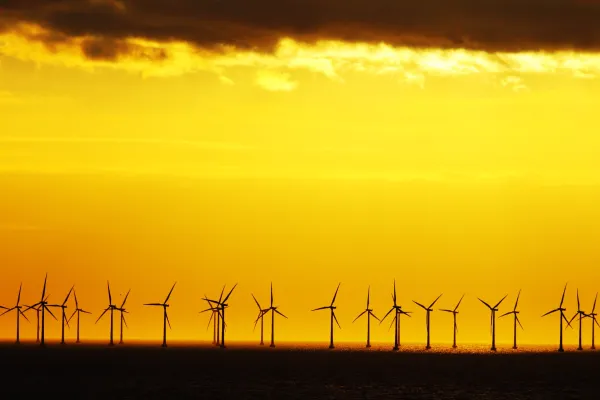
"Wind power" by Håkan Dahlström is licensed under CC BY 2.0.
Amidst Donald Trump’s wild Mideast War declarations, the tech billionaire push for nuclear reactor suicide has escalated with the shock relicensing of California’s two nuclear power plants at Diablo Canyon, now being pushed by the state’s “liberal” Governor Gavin Newsom, who has also joined Trump in their all-out attack against renewable energy.
Together Trump and Newsom are pushing decrepit, virtually uninsured, militarily indefensible nuclear power plants whose drastic deregulation may now rival the dangers posed by any bombs Iran could produce
They also make no economic or ecological sense.
Despite the latest tsunami of “Nuclear Renaissance” hype, atomic power plants are losing bigly to the worldwide surge in renewable energy. Solar panels, wind turbines, geothermal, and epic advances in battery storage continue to make the green alternative to fossil fuels and nuclear reactors—big and small—a far cheaper, safer, cleaner, more reliable, more job-producing alternative.
Despite the all-out Trump/Newsom anti-green attack, the “independent global energy think tank” Ember reported last month that“the world installed a record 814 GW of new solar and wind capacity in 2025, 17% more than in 2024 (696 GW).”
“The latest additions bring the combined global installed capacity of wind and solar to 4,174 GW (over 4 TW),” it said.
One GW (gigawatt) equals a billion watts, roughly the capacity of a big nuclear power plant; a TW is a trillion watts.
London-based Ember adds that “solar accounted for the majority of new capacity additions, with almost 4 GW of new solar added globally for every 1 GW of wind.”
Reuters reported last month: “Renewable power made up almost 50% of the world’s electricity capacity last year after a record increase in solar installations.”
Despite the nuke power push, some 90% of Earth’s annual newly installed generating capacity for the past few years has been solar, wind or geothermal, with battery backup.
Nonetheless, Republican Trump says “nuclear’s a great energy.” Last year, the Trump family’s media company announced a merger with TAE Technologies, a California-based nuclear fusion company, in a deal worth over $6 billion. Meanwhile his flood of self-serving pro-nuke executive orders have weakened or eliminated nuclear safety regulations, making the reactors easier to build and more dangerous than ever. Last year his administration finalized an $80 billion deal with Westinghouse for new nuclear power plants.
Trump is also attacking wind turbines everywhere. He’s allocated a $928 million chunk of taxpayer cash to kill a French-proposed offshore wind project and to instead fund Texas gas/oil projects, some of which will go for export.
Trump’s all-out war on renewables has been joined by Newsom’s pro-utility rate hikes, virtually killing California’s once-booming rooftop photovoltaics industry, costing thousands of jobs and billions in rate hikes. Even a proposed “balcony solar” bill would strictly limit a technology now cheap, reliable and enough to power the whole state, as it does for part of almost every day. Diablo’s hyper-expensive billionaire-boosted “base-load power” interferes with the renewables and vastly raises the rates Californians must pay.
Trump-style, Democrat Newsom has also backstabbed a 2018 comprehensive plan he had approved to phase in a 100% renewable energy-based state grid while phasing out the embrittled, hyper-expensive Diablo reactors, which are surrounded by earthquake faults.
Trump has promised many millions to cover a loan to keep the money-losing Diablo operating. But state legislators fear he may leave them holding much of the bag. They could instead reject NRC’s 20-year license extension, and close Diablo instead in 2030.
But Newsom (who’s term-limited this year) will be pushing hard, even as his Diablo betrayal underscores nuke power’s global economic failure.
The two nuclear power projects in the U.S. since 2000 have been fiscal fiascoes. Construction of two plants in South Carolina was abandoned, wasting $9 billion while producing zero electricity. Two plants at Vogtle, Georgia, opened seven years late, costing nearly $40 billion, more than double their original price. Projected cost estimates for the unproven but ceaselessly hyped “Small Modular Reactors” vastly exceed current prices for proven battery-backed solar, wind and geothermal.
And from the Diablo Canyon nuclear power plants in California to the Palisades plant in Michigan to the Indian Point plants in New York and onto Ukraine and Iran, the perils of nuclear power are clear.
Coupled with nuclear war, nuclear power—hyped as “Atoms for Peace” in the last century—and the more than 400 nuclear power plants worldwide that are now in operation, 94 of them in the United States, constitute lethal threats. The ability of the human species to survive on this planet is being put in nuclear danger, and not just at Diablo Canyon.
Kevin Kamps, executive director of Don't Waste Michigan, the statewide anti-nuclear coalition founded in the mid-1980s, commented in an interview: “The nuclear industry's massive campaign contributions to help get its preferred politicians elected in the first place, and it’s even more massive lobbying expenditures to influence office holders and government bureaucrats, explains its stranglehold on law and regulation—it’s the best pro-nuclear democracy money can buy, to paraphrase Greg Palast," said Kamps. (Palast is the author of the book The Best Democracy Money Can Buy.)
"The industry barbarians are so running rampant through the 'Halls of Power,' we might as well just hand over the keys to the U.S. Treasury to the nuclear lobbyists and their bosses," says Kamps.
"Nearly $400 billion in nuclear power bailouts, at federal taxpayer expense, was authorized in just three bills—the Infrastructure Investment and Jobs Act of 2021, and the Inflation Reduction Act of 2022 as well as the absurdly named, downright dangerous ADVANCE Act of 2024 ("Accelerating Deployment of Versatile, Advanced Nuclear for Clean Energy"). The three bills, signed into law by President Biden, teed up the current even more outrageous giveaways under Trump, not to mention the regulatory free fall, without a parachute, regarding safety, security, health, and the environment.”
“Such collusion,” said Kamps, “between safety regulators, industry, and government officials, was the root cause of the still unfolding Fukushima Daiichi nuclear catastrophe that began in 2011, the Japanese Parliament officially concluded after its year-long independent investigation, the first in its history."
“After successfully lobbying Michigan Governor Gretchen Whitmer to champion the unprecedented zombie reactor restart of the infamous, closed Palisades reactor, and to grant Holtec $300 million of state taxpayer funding for its trouble, the head of the University of Michigan nuclear engineering department was downright giddy.” Todd Allen, as reported in Stateline, said: "You’re starting to see a lot of states transition to a position where they’re supportive of nuclear. And compared to 30 years ago, the amount of federal support for nuclear is unbelievable.”
Said Kamps: “It is unbelievable, in a shocking, horrifying, insanely exorbitant, and extremely risky sense.”
The U.S. Nuclear Regulatory Commission, emasculated by Trump, has just extended the operating licenses of the two Diablo Canyon nuclear power plants by 20 years.
They are now more than 40 years old—with 40 years the length of time nuclear regulators originally set as the limit for a nuclear power plant running before its innards became embrittled by radioactivity leaving them prone for accidents. And. indeed, both Diablo Canyon plants are now deeply embrittled.
Further, the earthquake faults that surround the Diablo Canyon nuclear plants could easily trigger a catastrophic accident. Indeed, the other major industry in the area of the Diablo Canyon plants are hot spas.
The plants were to be shut down, Unit 1 in 2024 and Unit 2 in 2025, but California Governor Newsom, a Democrat, led in undoing that arrangement.
In the middle of the U.S., the Palisades nuclear plant was closed in 2022, after five decades of operation, and Holtec International got a contract to decommission it. But then Holtec turned around and said it would instead restart the plant. It would be first restart of a closed nuclear power plant in U.S. history.
Last week, Don’t Waste Michigan warned of “dire consequences” in a little more than a year following a restart. It issued a report by Arnie Gundersen, a nuclear engineer with 55 years experience, that cited a document of Holtec contractor, Framatone, that said “if Palisades is allowed to restart, the steam generators will degrade quickly.”
Gunderson said Framatone “determined that Palisades cannot operate safely even after just the first 14.5 months. Holtec's contractor admits the likelihood of damage will increase 'exponentially' after that point if Palisades is restarted.”
The proposed restart has been made possible by $3.12 billion in federal grants and loans and funds from the state of Michigan with Michigan Governor Whitmer, a Democrat, a major advocate of a Palisades restart.
As Roger Rapoport, an author and journalist who has long reported on nuclear power and also Palisades, wrotelast month in the Detroit Free Press, how Holtec International’s purported “unprecedented milestone in U.S. nuclear energy” may be turning into a millstone. Holtec is attempting the first-ever reopening of a nuclear plant permanently closed for decommissioning—the Palisades reactor….Twenty-one months into the project, Holtec has announced delay after delay while continuing to draw vast public subsidies…”
Currently, “Holtec seeks exceptions from Nuclear Regulatory Commission for work on a reactor so noncompliant that no government agency would even consider approving its construction today….After multiple delays…Holtec, a New Jersey company with zero nuclear reactor operating experience, is back in line at the Nuclear Regulatory Commission seeking forgiveness for unpermitted welding on the 55-year-old Palisades reactor pressure vessel containment head.”
This “follows a controversial NRC exemption related to re-sleeving approximately 1,400 cracked tubes at the plant’s ancient steam generators…”
Meanwhile, in New York at the site of the Indian Point nuclear power plants—25 miles from New York City—U.S. Department of Energy Secretary Chris Wright, formerly CEO and founder of a fracking company, joined last month with Republican Congressman Mike Lawler of New York calling for the reopening of the two plants.
One plant was shut down in 2020 and a second in 2021 because of safety concerns related to the plants being located in the most densely populated area of the U.S. Some 22 million people live within 50 miles of the nuclear plants. The two plants began operating in 1974 and 1976.
Holtec also got the contract to decommission these plants. Holtec International President Kelly Trice declared interest in his company restarting them instead, at a cost of $10 billion. “I’m getting so many people asking me from New York if this is possible,” he said. “The answer is yes.”
Even on Long Island, east of New York City, where the Long Island Lighting Company proposed nearly 60 years ago to build seven to eleven nuclear power plants, suddenly a pro-nuclear voice has emerged. There was strong opposition from the grassroots and from the government of Suffolk County, where the plants were to be located, and the scheme was blocked, along with the opening of the one plant built, at Shoreham.
Among issues raised in the decades-long battle against nuclear power on Long Island was how the eight million people on Long Island could evacuate in the event of a major nuclear plant accident—considering that the only ways off Long Island are several bridges and tunnels into New York City.
But, last week, John Duffy, treasurer and business manager of Local 138 of the International Union of Operating Engineers, wrote in Long Island Business News a piece which included the heading that “let’s repower Shoreham.”
“It won’t be easy or cheap,” he wrote, “but if you aren’t prepared to shut down all your electronics, and unplug your car, then you are going to have to make up that Long Island energy shortfall somehow. Let’s start with Shoreham. For those with short memories, the Shoreham Nuclear Power Plant was a $6 billion, 820-megawatt nuclear reactor on the Island’s north shore, overlooking the Long Island Sound….Public opposition led to its closure without ever operating commercially. The plant was decommissioned in 1994…”
The “licensing process must start all over again. You would also have to essentially build a new reactor on the site, but with the Trump administration championing nuclear across the country, that process might easily be expedited by Washington,” he continued.
“The Trump administration would also need to review and approve a revised emergency evacuation plan, an issue that was used back in the 1980s to block Shoreham’s operation,” he went on. “FEMA declared it was impossible to resolve the challenged, but one suspects today’s FEMA would find a solution.”
The Trump administration has not announced interest in nuclear power on Long Island, but Trump has been highly active in trying to block a nuclear-alternative source of electricity for this 120-mile island jutting out into the sea, offshore wind projects.
Meanwhile, New York Governor Kathy Hochul has declared her complete support of nuclear power. She declared last year in a presentation that, regarding nuclear power, “I’m the first Democratic Governor [of New York] in a generation to say to nuclear, ‘I’m embracing this.’ My state will embrace this.”
She also, in her state of the state address this year, called for the construction of five gigawatts of new nuclear power in the state—the equivalent of five large nuclear power plants. And her Public Service Commission last year approved $33.3 billion to be paid by every electric ratepayer in New York State as a subsidy for four nuclear power plants in upstate New York, including Nine Mile Point 1, the oldest nuclear power plant now running in the United States.
Meanwhile, overseas, in the wars in Ukraine and Iran, nuclear power plants have become examples of what Dr. Bennett Ramberg, an internationally known expert on nuclear proliferation, wrote about in his book “Nuclear Power Plants as Weapons for the Enemy: An Unrecognized Military Peril,” first published in 1980. In it he wrote that “despite multiplication of nuclear power plants, little public consideration has been given to their vulnerability in time of war.”
When Putin sent troops pouring through Belarus into northern Ukraine in 2022, they quickly assaulted the remains of the Chernobyl nuclear power plant, which exploded in 1986. The core of Unit 4 has been covered with a $2 billion sarcophagus funded by European nations.
Since then, Russia has used drones at the Chernobyl site which have punctured the sarcophagus. And has also attacked the six-reactor Zaporyzhia nuclear plant site in Ukraine.
In Iran, there have been attacks at the Bushehr nuclear power plant. Just last month, the International Atomic Energy Agency reported that "following information from Iran of a projectile incident on Tuesday evening, the IAEA can confirm that a structure 350 metres from the Bushehr NPP reactor was hit and destroyed." IAEA Director General Rafael Mariano Grossi said: "Although there was no damage to the reactor itself nor injuries to staff, any attack at or near nuclear power plants violates the seven indispensable pillars related to ensuring nuclear safety and security during an armed conflict and should never take place."
But they are taking place—and can be expected to continue because, indeed, nuclear power plants can be “weapons for the enemy” and, indeed, this largely remains an “unrecognized military peril.”
A measure of the impacts of a nuclear plant disaster are detailed in the book “Chernobyl: Consequences of the Catastrophe for People and the Environment.”
Published by the New York Academy of Sciences in 2009, it was authored by three noted scientists: Russian biologist Dr. Alexey Yablokov, former environmental advisor to the Russian presidents Gorbachev and Yeltsin; Dr. Alexey Nesterenko, a biologist and ecologist in Belarus; and Dr. Vassili Nesterenko, a physicist and at the time of the accident director of the Institute of Nuclear Energy of the National Academy of Sciences of Belarus. Its editor was Dr. Janette Sherman, a physician and toxicologist long involved in studying the health impacts of radioactivity.
The book is based on health data, radiological surveys and scientific reports—5,000 documents. It concluded that based on the records that were scrutinized, some 985,000 people died largely of cancer caused by the Chernobyl accident in nations that underwent radioactive fallout from the disaster. That was between when the accident occurred in 1986 and 2004. More deaths, it projected, would follow. And they have.
Contrary to the industry hype, all atomic reactors emit planet-killing radioactive Carbon 14. They directly heat the planet, destroy our lakes, rivers and oceans with chemicals and radiation, kill millions of fish per year. They create radioactive waste for which there is no safe place on this planet. Their “normal” radiation releases ceaselessly harm and kill untold thousands of downwind neighbors.
And with the latest planet-killing “Nuclear Renaissance” now in play, there will be more and more deaths from nuclear power—unless there is a stop put to this failed, deadly, hyper-expensive technology, with our species finally taking the true Solartopian road.
***
Karl Grossman is the author of Cover Up: What You Are Not Supposed to Know About Nuclear Power and host of the TV program “Enviro Close-Up,” distributed by Free Speech TV and broadcast on nearly 200 cable TV systems in 40 states an the major satellite TV networks.
Harvey “Sunny” Wasserman wrote Solartopia! Our Green-Powered Earth and co-wrote Killing Our Own: The Disaster of America’s Experience with Atomic Radiation. He co-hosts California Solartopia at KPFK.org and, most Mondays (2-4pm PT) the Green Grassroots Emergency Election Protection (GREEP) Zoom, https://grassrootsep.org